
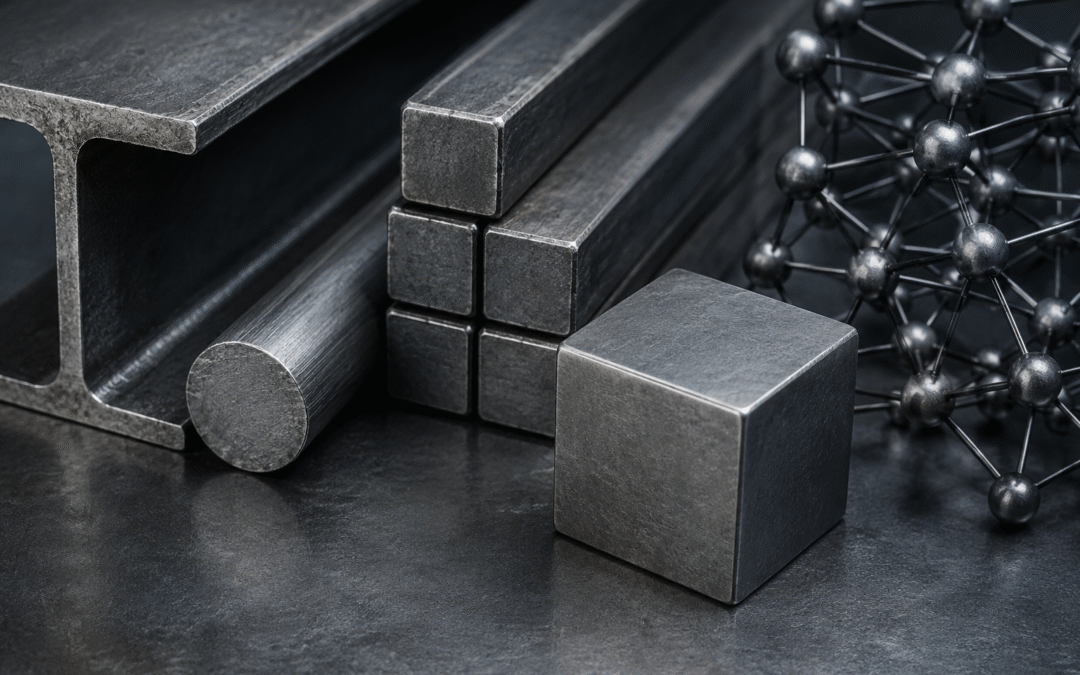
Carbon steel is a powerful combination of iron and carbon, with a few more metals added. It is durable, but can be difficult to work with if it contains a lot of carbon. It is widely used in construction, automobile manufacturing, and mechanical engineering. It is also popular for creating blades and tools due to its low cost and ease of shaping. However, if not properly maintained, it will rust. The density of carbon steel is essential because it determines how strong it is and where it can be utilized, making it helpful in a variety of industries and daily life.
Today, we will delve into the interesting realm of carbon steel density, examining its complexities and impact on the material’s qualities.
Why is carbon steel’s density important?
Carbon steel density is important in engineering and production because it impacts the material’s weight, strength-to-weight ratio, and overall strength in various dimensions.
What is the density of carbon steel?
Carbon steel has a density of around 7.8 g/cm3 or 0.284 lb/in3. This can vary slightly depending on the type of carbon steel, ranging from 7.75 g/cm3 (0.282 lb/in3) to 8.05 g/cm3 (0.291 lb/in3). Carbon steel is lighter than many metals, including stainless steel and copper alloys, but heavier than aluminum.
How does density influence carbon steel properties?
Carbon steel’s density influences its major qualities. Higher density typically indicates more strength and resistance to deformation, needing more energy to alter shape. It does, however, result in decreased electrical conductivity, higher heat capacity, and enhanced thermal expansion rates when exposed to temperature or pressure variations. These characteristics influence how carbon steel behaves and performs in a variety of applications, therefore density is a significant consideration in material selection.
What are the elements influencing carbon steel density?
Carbon content: The more carbon in the steel, the denser it is.
Heat treatment: Changing how steel is treated can affect its density.
Temperature and pressure: Environmental factors can influence steel density.
Grain size: The size of the grains in a steel construction influences its density.
Surface treatment: Any treatments performed on the steel’s surface can affect its density.
What is the carbon steel density in kg/m3, g/cm3, and lbs/in3?
Carbon steel has a density of 7850 kg/m³ or 7.85 g/cm³ (0.284 lbs/in³). This figure, however, is not fixed and can vary slightly from 7.75 g/cm3 (0.282 lb/in3) to 8.05 g/cm3 (0.291 lb/in3) depending on the type of carbon steel used and the presence of additional alloying elements. For example, high-carbon steel is somewhat denser than low-carbon steel.
Density Low Carbon Steel Chart
Low carbon steel density varies by grade and composition, but commonly ranges from 7.75 to 8.05 g/cm³ (0.282 to 0.291 lb/in³).
Here’s a table with the densities of several typical low carbon steel grades:
| Grade | Density (g/cm³) | Density (lb/in³) |
| AISI 1005 | 7.85 | 0.282 |
| AISI 1006 | 7.85 | 0.282 |
| AISI 1008 | 7.85 | 0.282 |
| AISI 1010 | 7.85 | 0.282 |
| AISI 1011 | 7.85 | 0.282 |
| AISI 1012 | 7.85 | 0.282 |
| AISI 1013 | 7.85 | 0.282 |
| AISI 1015 | 7.85 | 0.282 |
| AISI 1016 | 7.85 | 0.282 |
| AISI 1017 | 7.85 | 0.282 |
| AISI 1018 | 7.85 | 0.282 |
| AISI 1019 | 7.85 | 0.282 |
| AISI 1020 | 7.85 | 0.282 |
| AISI 1021 | 7.85 | 0.282 |
| AISI 1022 | 7.85 | 0.282 |
| AISI 1023 | 7.85 | 0.282 |
| AISI 1025 | 7.85 | 0.282 |
| AISI 1026 | 7.85 | 0.282 |
| AISI 1110 | 7.83 | 0.281 |
| AISI 1117 | 7.83 | 0.281 |
| AISI 1118 | 7.83 | 0.281 |
Difference Between Carbon Steel and Stainless Steel
| Physical Features | Stainless Steel | Carbon Steel |
| Melting Point | The melting point of stainless steel varies between 1375 to 1530 Deg C, which is less than carbon steel. | Typically, Low Carbon Steel has a melting point of 1410 Deg C. The melting point of high Carbon steel ranges between 1425-1540 Deg C, which is greater than stainless steel. |
| Average Density | The average Density of Stainless Steel is 8000 Kg/m3, which is slightly heavier than Carbon Steel. | The average Density of Carbon Steel is 7850 Kg/m3, which is less than stainless steel. |
| Co-Efficient of Linear Thermal Expansion | Depending on grade, the coefficient varies in the range of (10-17.3) X10-6 m/ (m °C). The expansion coefficient of Stainless Steel is comparatively more than that of Carbon Steel. | The thermal expansion coefficient for carbon steel varies in the range of (10.8 – 12.5) X 10-6 m/ (m °C). This is generally less than stainless steel. |
How Does Density Affect the Properties of Carbon Steel?
Several critical properties of carbon steel are heavily influenced by density, including:
Carbon steel’s high density, combined with its inherent strength, result in a good strength-to-weight ratio. This means you can attain the necessary strength without adding too much weight, making it perfect for applications such as airplane construction.
Corrosion resistance: While carbon steel is not as corrosion resistant as stainless steel, its density allows it to create a protective oxide layer on its surface. This layer aids in corrosion resistance in specific conditions.
Machinability: Carbon steel’s machinability is influenced by its density. Its greater softness compared to other metals, such as titanium, makes it easier to manufacture and shape into desirable shapes.
Conclusion:
To summarize, carbon steel density has a substantial impact on a variety of qualities, including strength-to-weight ratio, malleability, ductility, electrical conductivity, heat capacity, and thermal expansion. A thorough understanding of these elements enables engineers and designers working in a variety of fields, such as automobile components and construction materials. This knowledge enables customers to make informed judgments about the best grade or kind of carbon steel for their unique needs, taking into account both cost and application-specific performance factors. With this knowledge, engineers and designers can make well-informed decisions when choosing the appropriate grade or type of carbon steel for their projects, balancing cost considerations with the performance requirements specified for each application area where this material may be used.
