
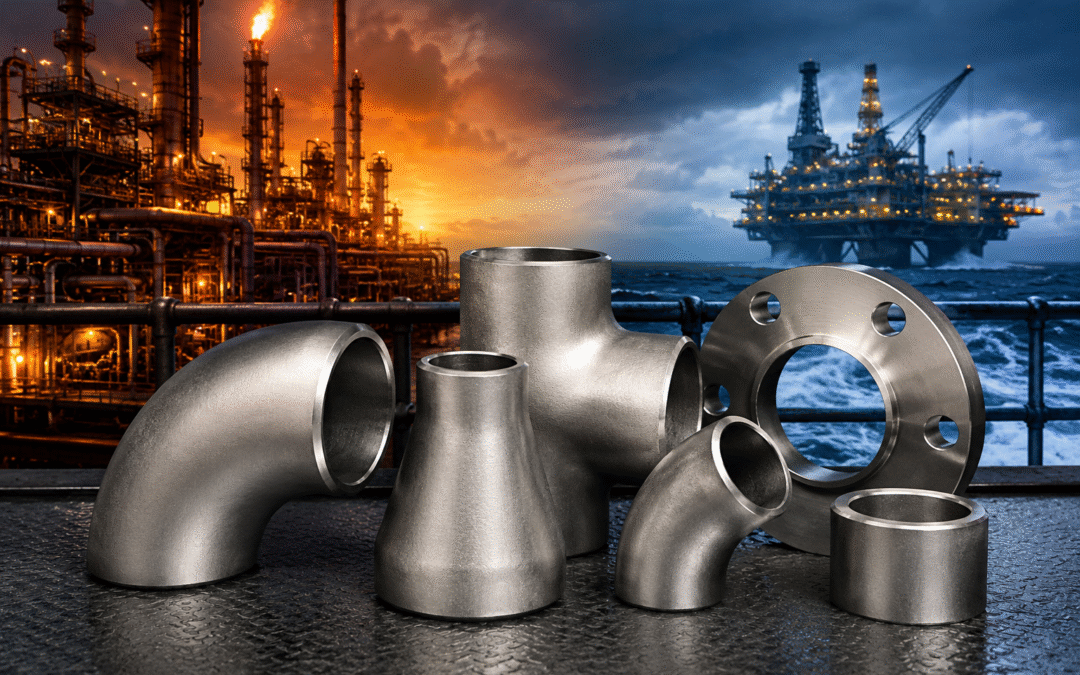
Aerospace, offshore chemical processing, power generation, and marine engineering all require piping components that can withstand extreme temperatures and corrosion. Nickel alloy pipe fittings are specifically engineered for these challenging settings, providing exceptional mechanical strength, oxidation resistance, and chemical stability. Common fittings used in Inconel pipe systems include elbows (45° and 90°), equal and reducing tees, reducers, couplings, and end caps, which are available in butt-weld and socket-weld styles. Different alloy grades provide distinct performance advantages. For example, Inconel 600 fittings properties provide excellent resistance to oxidation and corrosion at elevated temperatures, whereas Inconel 601 fittings applications are widely preferred in high-heat environments due to superior oxidation resistance. These high temperature corrosion resistant fittings provide long service life and dependable performance in key industrial applications requiring strength and corrosion resistance.
What are Inconel Pipe Fittings? Grades, Configurations, and Use Cases
Inconel pipe fittings are parts that link, manage, or reroute fluid flows in industrial piping systems. Common Inconel fitting types include elbows, tees, reducers, couplings, crosses, and end caps, which are available in butt-weld, socket-weld, and threaded configurations to accommodate various pipe system designs and pressure classes.Such fittings are crucial for ensuring the efficiency, safety, and dependability of pipe networks in sectors that require them. Nickel-chromium superalloys are widely employed in a variety of industries due to their strength and corrosion resistance in high-temperature conditions. It has the highest mechanical strength and oxidation resistance, making it ideal for applications where other materials would fail. Inconel fittings can withstand high pressure, heat, and chemical impacts, ensuring structural stability. Inconel fittings are often produced as Inconel 600 Fittings and Inconel 601 Fittings, which are widely utilized in chemical processing, power generation, and high temperature industrial systems.
Key Features of Inconel 600 and Inconel 601 Pipe Fittings
Inconel 600 fittings are distinguished by their superior chemical and mechanical performance, making them ideal for the most demanding industrial applications. Inconel 600 fittings are made of a nickel-chromium alloy (around 72% Ni, 14-17% Cr, and 6-10% Fe) that is resistant to oxidation and corrosion at high temperatures. Inconel 601 fittings add aluminium (1.0-1.7%) to the nickel-chromium-iron basis, increasing resistance to oxidation and carburisation at temperatures up to 1,200°C, making it the preferred grade for extreme-heat furnaces and thermal processing applications.
Because of these features, Inconel pipe fittings can be utilized to assure dependable service, long-term durability, and resistance to harsh conditions. They are ideal for essential applications because of their ability to tolerate high temperatures, oxidation, and chemical corrosion. As a result, these nickel alloy pipe fittings are used in industries such as aerospace, chemical processing, maritime engineering, and power generation, where the substance must function safely at high temperatures, pressures, and in corrosive conditions.
Inconel 600 vs. Inconel 601 Grade Comparison
Inconel 600 fittings (UNS N06600) are the preferred material for high-temperature service up to 1,100°C in reducing and mildly oxidizing conditions. They have good resistance to chloride-ion stress corrosion cracking and are commonly employed in chemical processing, nuclear applications, and heat exchangers.
Inconel 601 fittings (UNS N06601) incorporate aluminum into the alloy, considerably improving oxidation and carburisation resistance, making Inconel 601 the ideal standard for furnace components, heat treatment equipment, and gas turbine exhaust systems working above 1,000°C. Inconel 601 is the appropriate grade for applications that need cyclic heating, direct flame exposure, or carburising atmospheres.
Inconel pipe fittings conform to ASTM B366 (butt-welding fittings) and MSS SP-43 (wrought stainless steel and alloy butt-welding fittings). Pressure ratings are based on ASME B16.9 for buttweld and ASME B16.11 for socketweld and threaded types.
Key benefits of using Inconel pipe fittings
Inconel pipe fittings have several significant advantages, some of which are given below.
High Temperature Resistance: Inconel pipe fittings maintain full structural integrity at temperatures above 1,000°C, making them suitable for furnace components, turbine exhaust systems, and high-temperature chemical reactors.
Excellent Corrosion Resistance: These fittings are very resistant to acids, chemicals, and sea water, which aids in the corrosion resistance of piping systems. As a result, they are commonly used as high temperature, corrosion-resistant fittings in harsh environments.
Oxidation Resistance: Inconel fittings form a permanent, self-renewing passive oxide layer on their surface that resists oxidation at high temperatures, considerably prolonging service life when compared to carbon steel or conventional stainless steel fittings.
High Strength and Durability: The fittings are composed of Inconel pipe material, which is extremely strong and durable, allowing them to handle high pressure and mechanical stress in harsh industrial environments.
Fatigue and Creep Resistance: Inconel fittings are resistant to deformation under sustained mechanical stress and cyclic loading, which is crucial in high-pressure pipe systems that undergo thermal cycling, such as power plant heat exchangers and aerospace fuel lines.
Inconel versus stainless steel fittings
For service temperatures exceeding 600°C, chloride-rich conditions, or severe acid service, Inconel 600 or Inconel 601 fittings surpass 316L stainless steel fittings. Stainless steel 316L remains the most cost-effective option at temperatures below 600°C and mild corrosion conditions.
Inconel fittings typically cost 4–6% more than stainless steel. However, in locations where stainless steel is frequently replaced, such as offshore subsea systems or high-temperature chemical reactors, the longer service life of Inconel fittings results in a cheaper total cost of ownership during the asset’s lifecycle.
Key indicators for specifying Inconel over stainless steel:
Operating temperatures are consistently above 600°C.
Exposure to chloride-rich fluids and seawater
Strong acidic or alkaline process streams
Carburizing or oxidizing gas conditions.
Applications in which piping failure has safety or production ramifications.
Inconel 601 Fitting Applications and Industry Use Cases
Inconel Pipe fittings are critical components used in many industries to link various portions of their structures. The following lists the applications and usage of Inconel 601 fittings in various industries.
The aerospace industry makes substantial use of inconel pipe fittings due to their ability to tolerate high heat, vibration, and pressure cycling. They are commonly used in jet engines, gas turbines, and exhaust systems that require high-temperature functionality.
Chemical Processing Industry: Inconel pipe fittings are used in chemical plants and refineries for aggressive fluid transfer in settings where acids, alkalis, and chloride-rich process streams would quickly damage stainless steel fittings.
Inconel pipe fittings are also used in the maritime industry because they can survive corrosion and the severe climate of the sea, making them suitable for ship components and offshore equipment.
Inconel pipe fittings are used in power plants for boilers, heat exchangers, and high temperature piping systems where the material must be resistant to high temperatures and pressures.
