
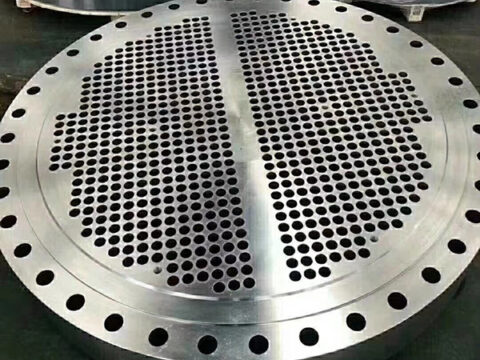
What is a Tube Sheet?
A tube sheet is a precision-engineered metal plate that supports and secures tubes inside heat exchangers, condensers, and pressure vessels. It provides structural stability, perfect tube alignment, and leak-tight separation of fluid zones.
Each tube hole is drilled and completed with micron-level precision to ensure uniform pitch, spacing, and sealing integrity. The system’s overall performance and service life are determined by the dimensional precision, surface finish, and metallurgical quality of the tube sheet.
Tube sheets are made from a variety of materials, including carbon steel, stainless steel, copper-nickel alloys, and high-nickel superalloys, which are selected based on operating temperature, pressure, and corrosion exposure. Cladded or bimetallic tube sheets are used in severely corrosive or aggressive situations to improve corrosion resistance while retaining structural strength.
Types of Tube Sheet
Tube sheets can be classed according to their design configuration, material composition, layout pattern, and intended application. Each classification focuses on certain engineering needs such as thermal expansion, corrosion resistance, cleaning accessibility, and pressure control. The right type promotes mechanical stability, leak-free performance, and longer equipment life.
Types of Tube Sheet by Design
Fixed Tube Sheet: Both sheets are permanently linked to the shell, resulting in a robust construction. It is the simplest and most cost-effective arrangement, ideal for clean-service applications in which the shell side does not require mechanical cleaning. When there are significant temperature differences between fluids, an expansion joint or bellow is employed to relieve thermal stress.
Floating Tube Sheet: In this design, one tube sheet is fixed and the other is free to move or “float,” allowing the tube bundle to expand and contract independently. This reduces stress and makes maintenance easier because the entire bundle can be removed for inspection. Floating designs are preferred in chemical, refinery, and power systems that encounter large temperature fluctuations or require periodic cleaning.
U-Tube Bundle: The U-tube configuration employs a single tube sheet with tubes bent into a U shape. This self-compensating design avoids the requirement for an expansion joint while maintaining high thermal flexibility. However, inside cleaning of the bent part is restricted. U-tube exchangers are employed for high-temperature and high-pressure applications, with the tube sheet always round to ensure even stress distribution.
Double Tube Sheet: This crucial design consists of two parallel tube sheets separated by a short leak detection gap. It completely isolates shell-side and tube-side fluids, eliminating cross-contamination. Double tube sheets are crucial in pharmaceutical, nuclear, and food-grade operations that need high product purity. They are usually circular to ensure accurate sealing and consistent loading.
Types of Tube Sheet by Material
| Material Type | Technical Overview | Applications & Advantages |
| Carbon Steel (CS) | High-strength, cost-efficient base metal for clean services. | Used in non-corrosive exchangers, ideal for rigidity and economy. |
| Cladded (CS + SS / Cu-Ni) | Dual-metal bonded for strength and corrosion resistance. | Seawater and chemical units, resists pitting and galvanic attack. |
| Stainless Steel (304L / 316L / Duplex) | Weldable, corrosion-proof alloys with hygienic surface finish. | Pharma, food and process plants, long life under thermal cycling. |
| Copper & Cu-Ni Alloys (70/30 | (90/10) | Excellent thermal conductivity and biofouling resistance. |
| High-Nickel Alloys (Inconel / Hastelloy) | High-temperature, oxidation- and chloride-resistant matrix. | Refineries, nuclear and chemical reactors, unmatched durability. |
Types of Tube Sheet by Layout Pattern
Tube sheets can also be classed based on the arrangement of tube holes, known as the tube layout or pitch pattern. This impacts how well heat is transferred, how fluid flows around the tubes, and how easy the tubes are to clean.
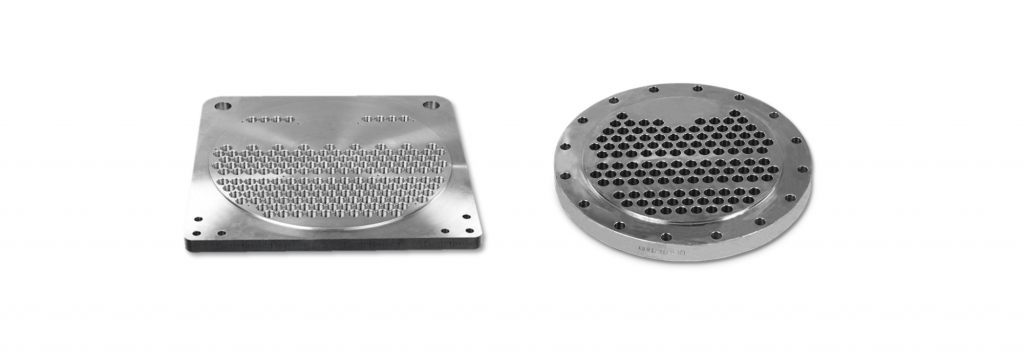
triangle Pitch (30° / 60° Layout): A triangle or staggered pitch allows for the maximum tube density, which maximizes heat transmission area. However, it inhibits cleaning access, therefore it is only suited for clean fluid services.
Square Pitch (90° Layout): In this pattern, tubes are arranged in a square grid. The open spacing allows for mechanical cleaning and a lower pressure drop, which is good for fouling or viscous fluids.
Rotated Square (45° Layout): The rotated square pattern strikes a compromise between heat efficiency and cleaning accessibility. It improves shell-side flow distribution and is utilized for moderate-duty activities.
Custom or Mixed Layouts: Some mix different layouts, such as a triangle core for compactness and a square exterior part for cleanability, to improve performance and maintenance.
These arrangement patterns are commonly used in manufactured components for shell-and-tube heat exchangers to provide precise flow distribution and effective heat transfer.
Applications of tube sheets in heat exchangers and processes
Tube sheets are the structural foundation of shell-and-tube heat exchangers, condensers, and pressure vessels, allowing for perfect tube alignment and leak-tight fluid separation. Their dependability directly influences thermal efficiency, pressure containment, and overall equipment life. Tube sheets are selected and fabricated based on process temperature, pressure, and fluid properties to ensure compatibility with each operating environment. The most popular industrial uses fall into the following sectors:
Tube sheets in this industry meet ASME Section VIII and TEMA specifications for cyclic thermal stress.
Oil and gas / petrochemical applications include reboilers, gas condensers, and fractionator exchangers. Tube sheets are frequently clad or bimetallic, combining carbon steel strength with corrosion-resistant alloys like Inconel, Cu-Ni, or Hastelloy to survive chlorides, hydrogen sulphide, and hydrocarbon exposure.
Chemical and process plants use evaporators, coolers, and reactors to manage acidic or alkaline fluids. Materials like stainless steel 316L, duplex, or cladded carbon steel provide corrosion resistance and dimensional stability in hostile chemical environments.
HVAC and refrigeration systems include condensers, evaporators, and industrial chillers. Round and square tube sheets enable compact layouts while maintaining good surface finishes (up to 0.8 Ra) for effective sealing and heat transfer.
Marine and offshore applications include critical components for seawater desalination, ballast water, and engine cooling systems. Copper-nickel or titanium tube sheets are biofouling resistant and provide long-term corrosion prevention in saltwater conditions.
Pharmaceutical and food processing applications include sanitary heat exchangers with twin tube sheets to prevent cross-contamination between product and utility fluids. Surfaces are machined to sanitary specifications to facilitate cleaning and validation.
Renewable & Energy Systems: Used in geothermal condensers, biomass digesters, and waste heat recovery units that require high temperature endurance and a long service life.
Newzel Industries manufactures ASME and TEMA compliant tube sheets with excellent dimensional accuracy and consistent machining quality. Tube sheets are produced using powerful multi-axis CNC and VMC technologies, ensuring ±100 µm hole tolerance and precise surface quality up to 0.8 Ra. Carbon steel, stainless steel, copper-nickel, and high-nickel alloys are used to suit a wide range of industrial applications, including power and chemical facilities, marine systems, and HVAC equipment. Every component is CMM inspected and process verified to assure uniformity, corrosion resistance, and long-term serviceability.
