
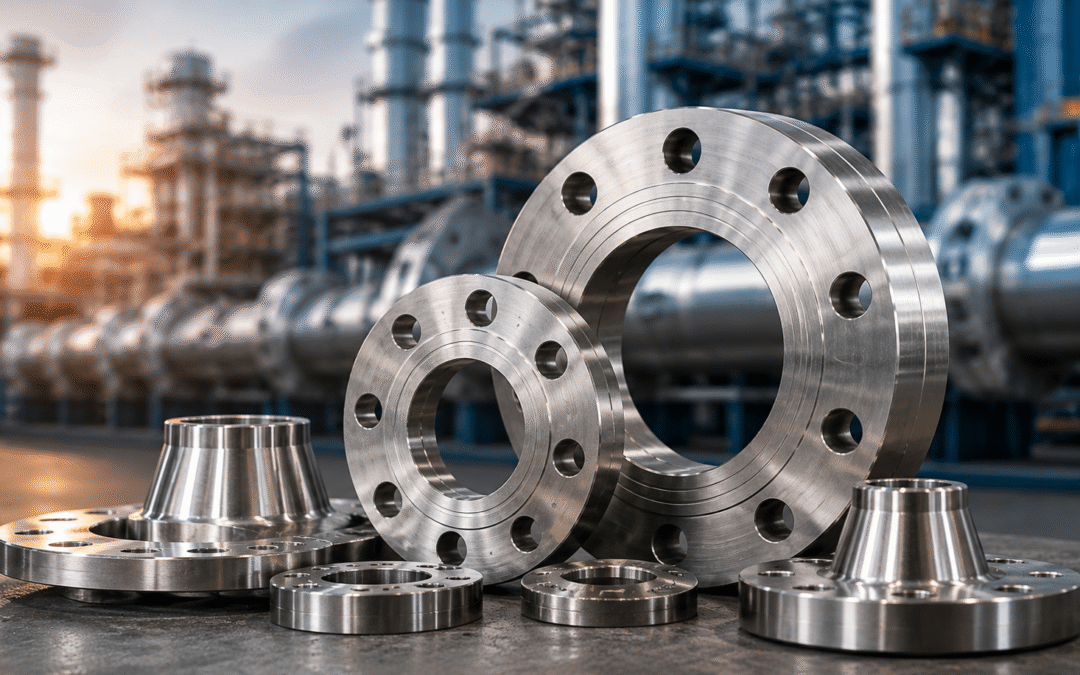
Steel flanges are among the most useful steel inventions in the field of technology. Although merely a connecting material, its design has a significant impact on how the complete machine performs. Flanges are metal rings, either forged or cast, that link pipe sections or unite the pipe to a pressure valve or another piece of equipment. They are also utilized in sporting equipment (like as skis) or in train wheels and rails, because they produce smooth motion.
Flanges are considered an internal component that facilitates machine maintenance. Their structural integrity is determined by the material from which they are produced, which is then determined by how the machine is used. They are often made of carbon steel, alloy steel, stainless steel, or steel with titanium and nickel alloys.
One of the primary benefits of flanges is the ability to quickly assemble and disassemble various machine components. This is critical not only for maintenance work, but also for the machine’s basic functionality.
There are various types of steel flanges, and the type determines the function. For example:
Threaded flanges use a screw-on mechanism, with the flange having threading inside and needing to be fixed to a pipe of the appropriate size. In the majority of cases, avoiding welding is beneficial.
Socket Weld flanges are ideal for tiny pipe diameters and applications requiring low temperatures and pressures. They’re also fairly straightforward to install.
Slip-on flanges are one of the most frequent types. They come in a variety of sizes and fittings, making them suitable for use in a wide range of machines. Although welding is required for installation, determining the appropriate size and fitting it on is a rather simple operation.
Lap joint flanges are two-piece construction. They require butt welding to be linked, but they are ideal for use in tight physical situations. They are also quite simple to disassemble because they are made up of multiple pieces.
Butt welding is also required when installing weld neck flanges. They have great integrity and are preferred in systems that require high pressure or high temperature work.
Blind flanges isolate pipe sections. They are blank disks that are fastened into position to stop the flow and act as a seal when properly placed.
Contact Newzel Industries for Steel Flanges
