
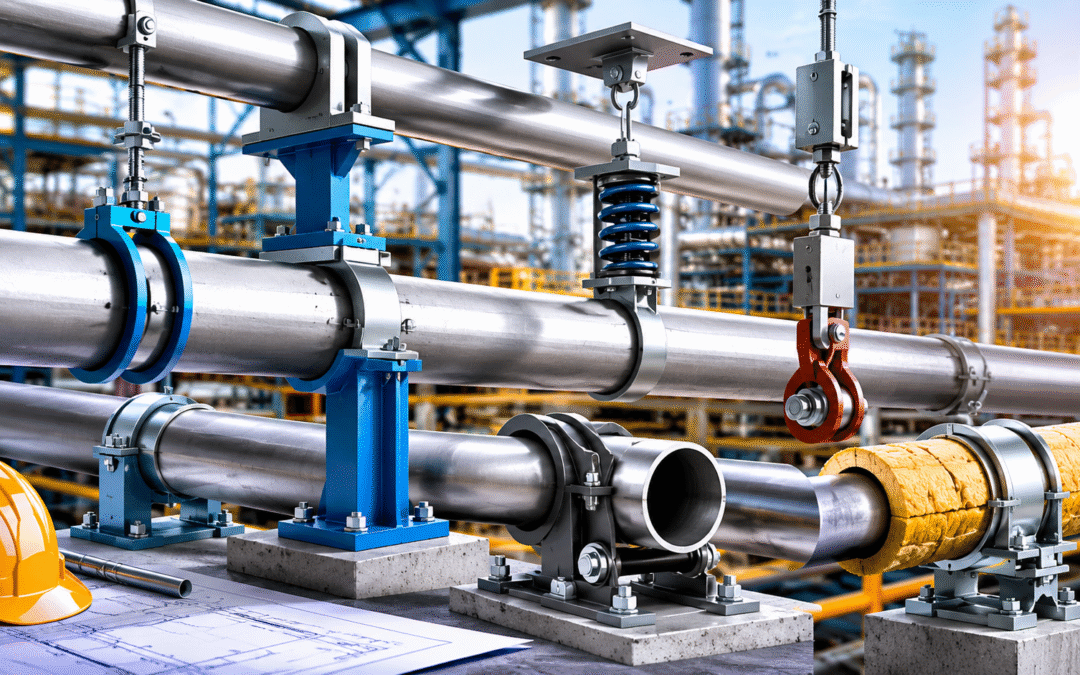
Pipe supports are crucial to ensuring the integrity, safety, and dependability of piping systems in oil and gas, petrochemical, power, and industrial facilities. Proper support selection reduces excessive stress, vibration, sagging, and equipment damage.
Common types of pipe supports:
✅ Rest Support: Supports the pipe vertically while allowing for axial movement.
✅Guide Support – Limits lateral movement and aligns the pipe while allowing longitudinal expansion.
✅ Anchor Support – Controls pipe movement in all directions and absorbs thermal and operational loads.
✅ Line Stop Support: Limits movement in one direction while allowing movement in others.
Spring Support (Variable and Constant) – Used where vertical thermal expansion occurs to reduce load transfer to equipment and pipelines.
✅ Hanger Support: Suspends pipe from structural components, frequently utilized in overhead piping systems.
✅ Shoe Support elevates the pipe from the supporting structure, distributing loads and protecting insulation.
✅U-Bolt Support secures piping to structural steel and is commonly used for small to medium-sized pipes.
✅ Trunnion Support – Ideal for vertical or elevated piping systems when traditional supports are unsuitable.
✅ Snubber Support – Prevents pipework from abrupt dynamic stresses like seismic activity, water hammer, or operational shocks.
Why is it important to have pipe supports?
• Control thermal expansion and contraction.
• Minimize vibration and fatigue failures.
• Protect the linked equipment and nozzles.
• Maintain the proper pipe alignment.
- Improve system dependability and service life.
A well-designed piping support system is equally crucial as the pipe itself. Understanding support types and their uses is critical for all pipe, mechanical, and maintenance professionals.
