
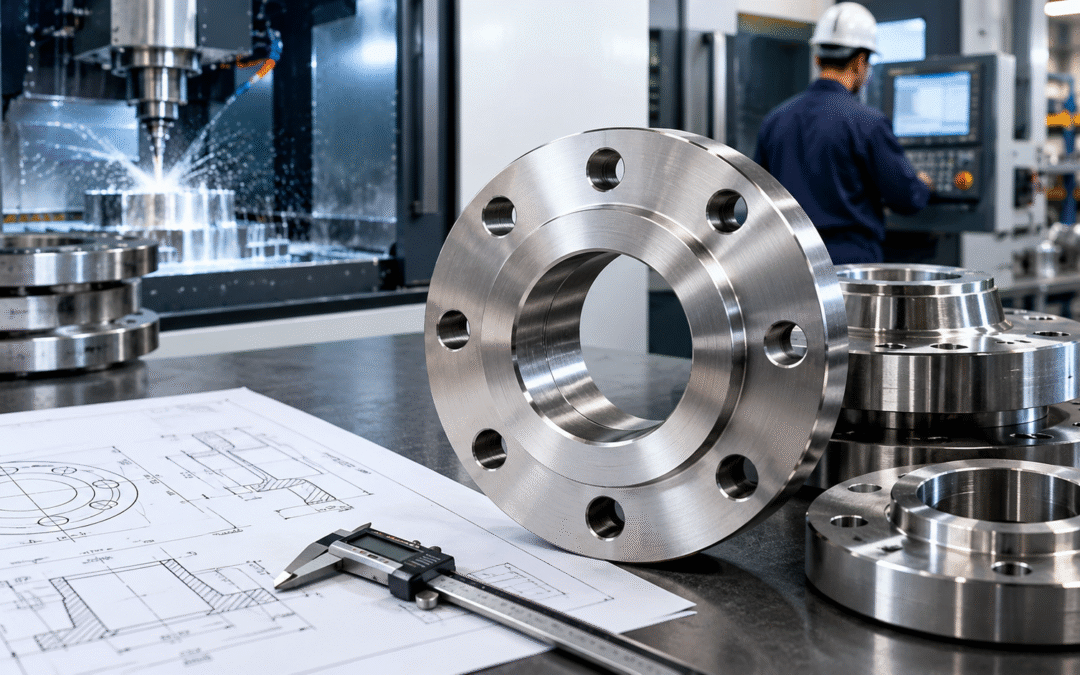
If you manage complicated piping systems in high-risk situations such as petrochemical refining, nuclear energy, or offshore platforms, you’re already aware that typical ASME catalog components have limitations. When your project has tight geometric constraints, non-standard pressure classes, or highly corrosive constituents, using an off-the-shelf item is a liability.
In these critical situations, you require a manufacturing framework that does not compel you to compromise. You need a partner who understands real, made-to-spec flange fabrication.
For procurement professionals and project managers, procuring a non-standard component is about more than just matching a drawing; it’s also about limiting risk and avoiding field adjustments. Here’s how a highly dependable, high-velocity forging process looks from start to finish.
Demanding Specifications Require Ready Material Inventory
A custom print is only as excellent as the raw material used to create it. When your application requires specialized chemistries that can endure extreme temperature cycling or hostile media, a manufacturer cannot afford to wait weeks for mill delivery.
To retain entire operational urgency, a great domestic forge company must keep a strong internal stockpile of varied alloy families ready for prompt production:
High-Yield Carbon and Stainless Steels: The foundation of durable mechanical integrity.
Duplex and Super-Duplex Stainless: Required for pitting resistance and high tensile strength in chloride-rich settings (e.g., Duplex 2205/2507).
Nickel alloys and exotics are non-negotiable for intense chemical processing (for example, Hastelloy C276, Alloy 20, Monel).
Titanium configurations provide maximum strength-to-weight performance and outstanding corrosion resistance (Grades 2/7/12).
Unpacking the Built-to-Spec component line.
True bespoke manufacturing entails having the facilities capacity to generate complicated geometries in a wide range of configurations. Whether your system requires a single-run unique shape or a high-volume production lot, the manufacturing capacity should smoothly encompass both conventional changes and totally custom blueprints weighing up to 2,500 pounds, including
High-Pressure Hubs: Weld Neck, Long Weld Neck, and Socket Weld profiles are machined to ensure proper stress distribution.
System isolation and flow measurement include blind flanges, orifice sets, and custom decreasing dimensions.
Slip-On, Threaded, Lap Joint, Stub Ends, and Studding Outlets designed for non-standard bolt circles.
The Blueprint for Errorless Forging Execution
When a component must work flawlessly under harsh service circumstances, the manufacturing process must be approached as a precise science. Because Newzel Industries is a committed Flanges manufacturer rather than an engineering design firm, our duty is to accurately transform your exact specs into a durable, field-ready component.
Our internal quality workflow includes four key checkpoints:
Step 1: Pre-production Drawing Review
Before manufacturing begins, a dedicated team of machinists and quality specialists examines the drawings you submit, including face dimensions (RF, RTJ, tongue/groove), and bolt-hole circles. We cross-check your specifications against our tools to achieve 100% manufacturing repeatability.
Step 2: Controlled Forging and Advanced Metallurgy.
The raw material is forged using rigorous open-die and ring-rolling procedures under stringent temperature conditions. This improves the internal grain structure by practically removing the subsurface cavities, porosity, and structural weak areas found in low-cost cast alternatives.
Step 3: precise CNC machining.
Rough forgings are sent directly to powerful internal CNC machining units. Here, the part receives its final bore measurements, precise hub tapers, and exquisite face finishes required to achieve a leak-proof gasket seal on the first attempt.
Step 4: Strict Compliance Certification.
A high-performance component is only as reliable as the documentation. True compliance entails providing full traceability, including verified Material Test Reports (MTRs), heat-treatment records, and non-destructive testing (NDT), all validated by our ISO 9001:2015 certified quality systems.
