
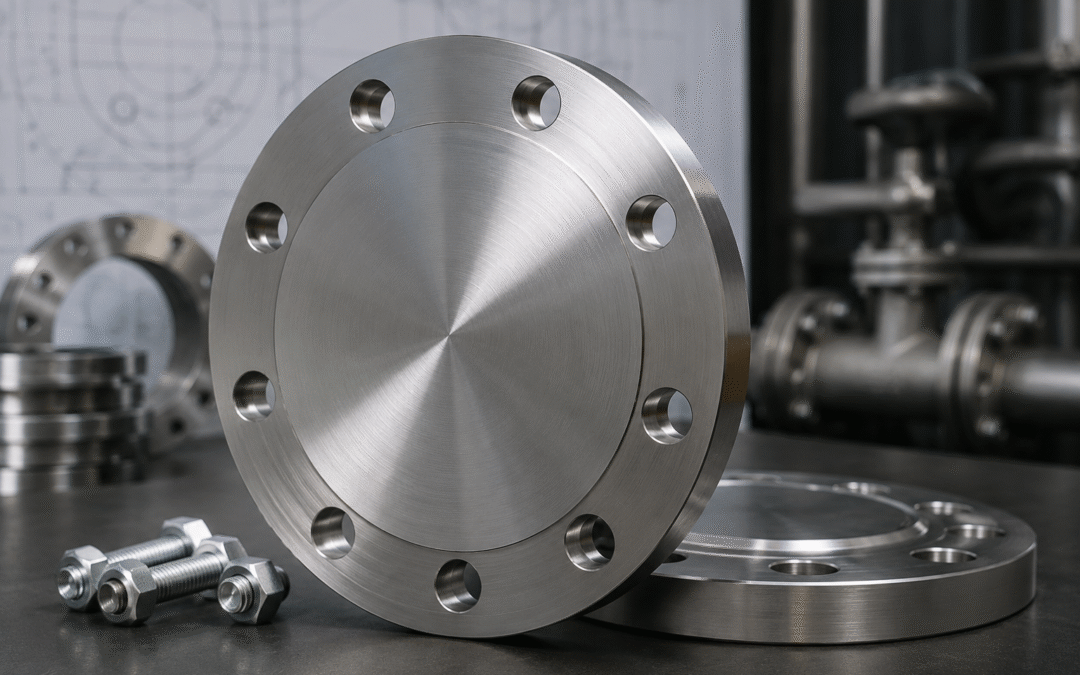
In the realm of plumbing, the most critical section of the system can be the one that completely stops the flow. Whether you’re preparing for a routine maintenance shutdown, performing a high-pressure hydrotest, or simply giving your plant room to expand, the blind flange is your first line of defense. At Newzel Industries, we’ve seen how selecting the correct “blank” can mean the difference between a successful operation and an expensive leak. This tutorial explains everything from blind flange applications to technical specifications in plain English.
What is a blind flange?
Consider a blind flange the “dead-end” street of a pipe system. It is a solid steel disk without a center hole. To seal the line, bolt it to the end of a pipe or vessel nozzle. Because it must withstand the whole force of the liquid or gas that strikes it, the blind flange thickness is frequently larger than that of any other flange in the system to handle mechanical stress.
Typical Blind Flange Applications and Uses
A blind flange is more than just a permanent plug; it’s a flexible tool for numerous industrial applications.
System Maintenance: If you need to repair a valve downstream, use a blind flange to “blank off” the line, ensuring the work area is safe.
Pressure Testing and Hydrotesting: In a hydrotest, a blind flange is utilized to shut off the segment of pipe being examined for leaks.
Future Expansion: Many Newzel engineers propose using a “T-junction” with a blind flange. When the plant wants to grow, just unbolt the flange and connect the new line.
Blind Flange vs. Pipe Cap: Unlike caps, which are often welded, blind flanges are bolted, making them considerably easier to remove for cleaning or inspection. For more complicated isolation during maintenance, some systems use ASME B16.5 Spectacle Blind Flanges, which allow for rapid changeover between open and closed flow modes.
Understanding Blind Flange Types thru Facing
You cannot simply grasp any blind flange and expect it to seal. The “face” of the flange must match the one it is bolted to. Blind flange varieties are mainly classified by their surface.
Raised Face (RF) is the industry workhorse. ASME B16.5 Blind Raised Face Flanges have a tiny lip that concentrates pressure on the gasket surface, resulting in a superior seal.
Flat Face (FF): Typically used when bolting to cast iron or fragile equipment. It prevents the flange from splitting when you tighten the bolts.
Ring-Type Joint (RTJ): The heavyweight. These have a machined groove for a metal ring and are used in high-pressure oil and gas pipelines.
Blind Flange Dimensions and Thickness (ASME B16.5)
One of the most common queries we receive at Newzel is about blind flange thickness. Because there is no center bore, the pressure is applied directly to the plate’s center. ASME B16.5 regulations specify measurements to prevent “bowing” or warping.
Blind Flange Dimensions Table (Class 150)
Measurements in Inches per ASME B16.5 standards
| Pipe Size (NPS) | Outside Diameter (OD) | Blind Flange Thickness | Bolt Circle (BCD) |
|---|---|---|---|
| 1″ | 4.25 | 0.56 | 3.12 |
| 2″ | 6.00 | 0.75 | 4.75 |
| 4″ | 9.00 | 0.94 | 7.50 |
| 8″ | 13.50 | 1.12 | 11.75 |
Choosing the Appropriate Blind Flange Pressure Rating
The blind flange pressure rating (or “Class”) represents the maximum allowed pressure at a certain temperature.
Match the Class: A Class 300 blind requires a Class 300 mating flange.
Temperature Impact: As the working temperature rises, the material’s pressure-holding capacity (such as carbon steel flanges or stainless steel flanges) diminishes.
Newzel Pro Tip: Always consult the Pressure-Temperature tables in ASME B16.5 before making your material selection.
Blind Flange Installation: A Step-by-Step Guide for Leak Prevention
A “leaky” flange is nearly always caused by poor installation, not a faulty component. Here is the Newzel guide to achieving a perfect, safe seal:
Inspect the Faces: Wipe the faces clean. Even a small amount of grit can cause a leak path.
Gasket Compatibility: Make sure your gasket fits the facing (e.g., spiral wound for RF). Never re-use an old gasket.
Tighten bolts in a star pattern, not circles. To apply pressure uniformly, go across the flange in a “star” sequence.
Final Torque Check: Use a calibrated torque wrench. Your “gut feeling” is rarely as precise as the set torque numbers!
Conclusion: Quality Blind Flanges by Newzel Industries.
From separating high-pressure pipes for safety to offering future-proof extension sites, the blind flange is a critical component of worldwide piping integrity. The only way to ensure a secure, leak-proof seal under extreme conditions is to select the appropriate ASME B16.5 rating and ensure that the flange face properly matches your existing system.
