
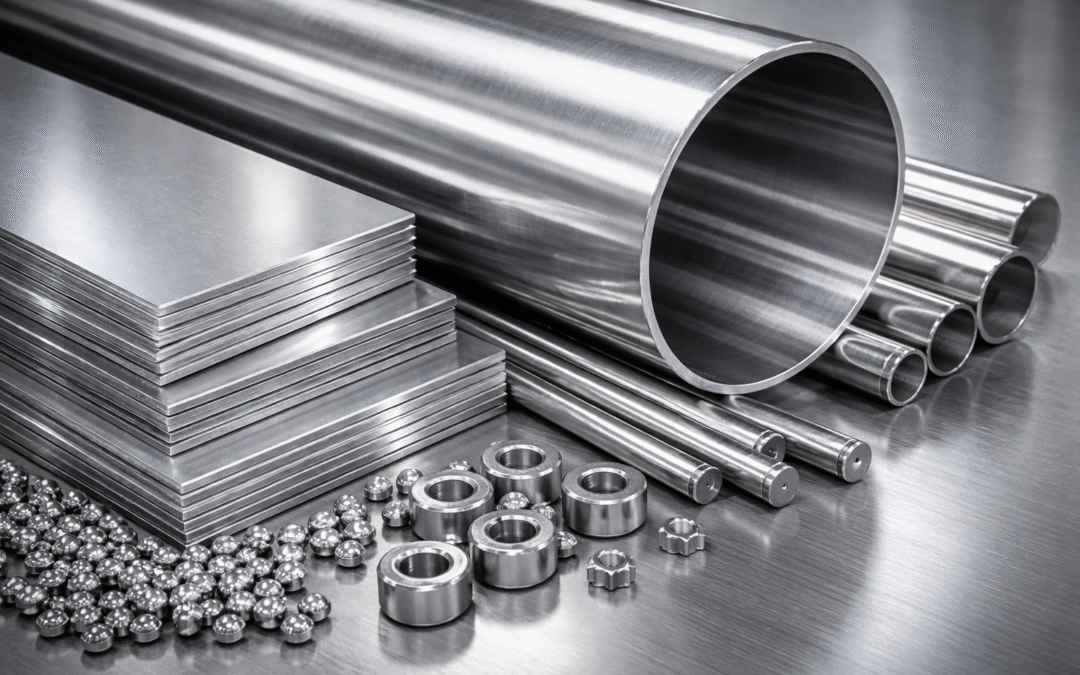
Stainless steel 304 and 304L are also known as 1.4301 and 1.4307, respectively. Stainless steel 304 is the most versatile and commonly used variety of stainless steel. It was previously known as 18/8 because of its nominal composition of 18% chromium and 8% nickel. This austenitic grade is extremely deep-drawable, making it ideal for sinks and saucepans. Stainless steel 304L is a low-carbon variant of 304 that is commonly used in heavy gauge components to improve weldability. Some goods, such as plates and pipes, may be available in “dual certified” material, which fulfills both 304 and 304L standards. Stainless steel 304H, a high carbon version, is also suitable for high-temperature applications. These characteristics are typical of flat-rolled products covered by the ASTM A240/A240M standards. While the parameters in these standards may be similar, they are not necessarily the same as those provided in this data sheet.
The density of stainless steel 304 is 7,930 kg/m3, or 7.93 g/cm3, which is equivalent to 0.286 lb/in3. A cubic meter of 304 stainless steel weighs 7,930 kg.
The formula for calculating density (ρ) is to divide the object’s mass (m) by its volume (V), represented as ρ=m/V. Density is measured using the International System of Units (SI) in grams per cubic centimeter (g/cm3), kilograms per cubic decimeter (kg/dm3), or kilograms per cubic meter.
| Stainless Steel | Density (g/cm3) | Density (kg/dm3) | Density (kg/m3) | Density (lb/in3) | Density (lb/ft3) |
| 304 | 7.93 | 7.93 | 7,930 | 0.286 | 495.05 |
Stainless Steel 304 Chemical Compositions
| Element | % Present |
|---|---|
| Carbon (C) | 0.07 |
| Chromium (Cr) | 17.50 – 19.50 |
| Manganese (Mn) | 2.00 |
| Silicon (Si) | 1.00 |
| Phosphorous (P) | 0.045 |
| Sulphur (S) | 0.015b) |
| Nickel (Ni) | 8.00 – 10.50 |
| Nitrogen (N) | 0.10 |
| Iron (Fe) | Balance |
Stainless Steel 304 Physical Properties
| Property | Value |
|---|---|
| Density | 8,000 Kg/m3 |
| Melting Point | 1450 °C |
| Thermal Expansion | 17.2 x 10⁻⁶ /K |
| Modulus of Elasticity | 193 GPa |
| Thermal Conductivity | 16.2W/m.K |
| Electrical Resistivity | 0.072 x 10⁻⁶ Ω .m |
Stainless Steel 304 Corrosion Resistance
Stainless steel 304 is highly corrosion resistant in a variety of settings and when exposed to corrosive media. However, it may experience pitting and crevice corrosion in chloride-containing conditions. Stress corrosion cracking may also develop at temperatures exceeding 60°C.
Stainless Steel 304 Heat Resistance.
Stainless steel 304 has excellent oxidation resistance in intermittent service up to 870°C and continuous service up to 925°C. However, it is not advised for continuous usage in the temperature range of 425°C to 860°C. In this scenario, 304L is selected since it is resistant to carbide precipitation. When strong strength is required at temperatures between 500°C and 800°C, grade 304H is recommended. Even at high temperatures, this material remains resistant to water corrosion.
304 Stainless Steel Heat Treatment
Heat treatment is not an appropriate method for hardening stainless steel 304. However, solution treatment or annealing can be performed by heating the material to a temperature between 1010 and 1120°C and quickly cooling it.
304 Stainless steel Applications
- Saucepans
- Springs, screws, nuts & bolts
- Sinks & splash backs
- Architectural paneling
- Tubing
- Brewery, food, dairy and pharmaceutical production equipment
- Sanitary ware and troughs
Why do you want to know the density of stainless steel?
Knowing the density of stainless steel is important because it allows you to calculate the weight of the metal depending on its volume.
This computation is useful in a variety of scenarios, including when metal makers need to calculate the weight of the metal to be melted before casting, utilizing the volume of the mold and the density of the metal.
Furthermore, the density of stainless steel is used to determine the weight of a variety of items, including steel wire, steel plate, steel pipe, and section steel.
Conclusion
To summarize, stainless steel 304 is a commonly used and versatile material that provides great corrosion resistance in a variety of settings. It cannot be hardened through heat treatment, but it can be treated with solution or annealed to get the desired characteristics. It is critical to understand the density of stainless steel since it enables for the computation of the metal’s weight based on volume, which is required in many production processes. Overall, stainless steel 304 is a dependable and popular material for applications ranging from sinks and saucepans to high gauge components that require better weldability.
